
Company news: the lime industry prepares for the challenges of 2050
As France's leading independent producer of natural hydraulic lime, Chaux Saint-Astier® is taking a key step in its sustainable transformation, building a CSR strategy as bold as it is innovative for the construction industry.
A clear, structured decarbonisation plan at the heart of a forward-looking climate strategy
A family business founded in 1912 and the French leader in natural hydraulic lime for the restoration of built heritage, Chaux Saint-Astier® has launched a comprehensive programme embedding CSR into its corporate strategy.
In June 2025, the lime producer announced the construction of a new decarbonised lime production unit by 2028 — a major step in its vision of a new place for lime in the homes of tomorrow.
Supported by the specialist consultancy Róng Yì Solutions, the company is now structuring its approach around the ACT Step-by-Step framework of ADEME (the French agency for ecological transition) and the CSRD/VSME framework, covering all environmental, social and governance dimensions.
This approach was built on the results of its carbon footprint assessment, carried out on 2023 data and covering the full scopes 1, 2 and 3:

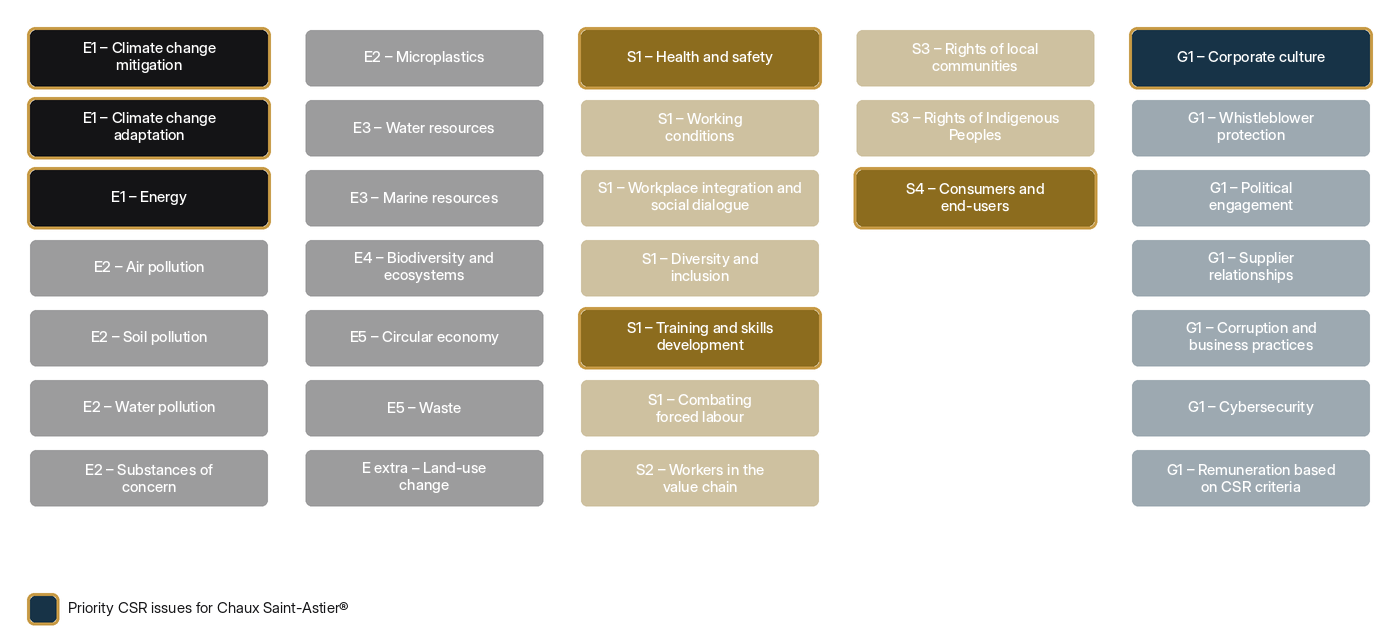
An in-depth diagnosis — double materiality analysis, value chain mapping, stakeholder identification, sector benchmarking — led to the definition of seven priority CSR issues:
- Climate change mitigation
- Climate change adaptation
- Energy
- Health and safety
- Training and skills development
- Customer and user relations
- Corporate culture
The company then defined a CSR vision for each of its priority issues, based on its values — Transmission, Agility, Authenticity, Audacity, Commitment — and its purpose: “Preserving History, Inspiring the Future”, to make these issues tangible in the years ahead.
The carbon footprint will be assessed again during 2026 (on 2024 and then 2025 data), in order to measure the first effects of this new course.
An ambitious climate roadmap
With a carbon footprint of 80,000 tonnes of CO₂ equivalent across scopes 1, 2 and 3, Chaux Saint-Astier® has set a clear decarbonisation trajectory:
- −20% emissions by 2030
- −45% by 2040
- −90% by 2050, to reach carbon neutrality
This strategy relies on several concrete levers:
- the construction of a new decarbonised production unit,
- the energy transition from coal to gas, then to a mix of alternative fuels to reduce the environmental footprint as much as possible,
- the accelerated integration of bio-based and circular materials into its products,
- the deployment of solutions to capture unavoidable process CO₂, essential to reach carbon neutrality by 2050.
Challenges that match an ambition: keeping alive, in the heart of the Dordogne, a unique, thousand-year-old expertise that today answers the major challenges of construction with remarkable relevance: thermal insulation, comfort in summer and winter alike, durability of buildings, a material perfectly compatible with plant-based construction, and the breathability of materials — and therefore of our homes…
Beyond reducing its footprint, the company also addresses adaptation to climate change — an angle still rarely tackled in the sector. Using a climate risk assessment based on the HazClim® methodology, Chaux Saint-Astier® anticipates the consequences of extreme events on its operations, supply chain and products, and develops solutions suited to the future conditions of construction.
The whole organisation trained and mobilised
The transition is not limited to industrial processes: it has also involved all 145 employees.
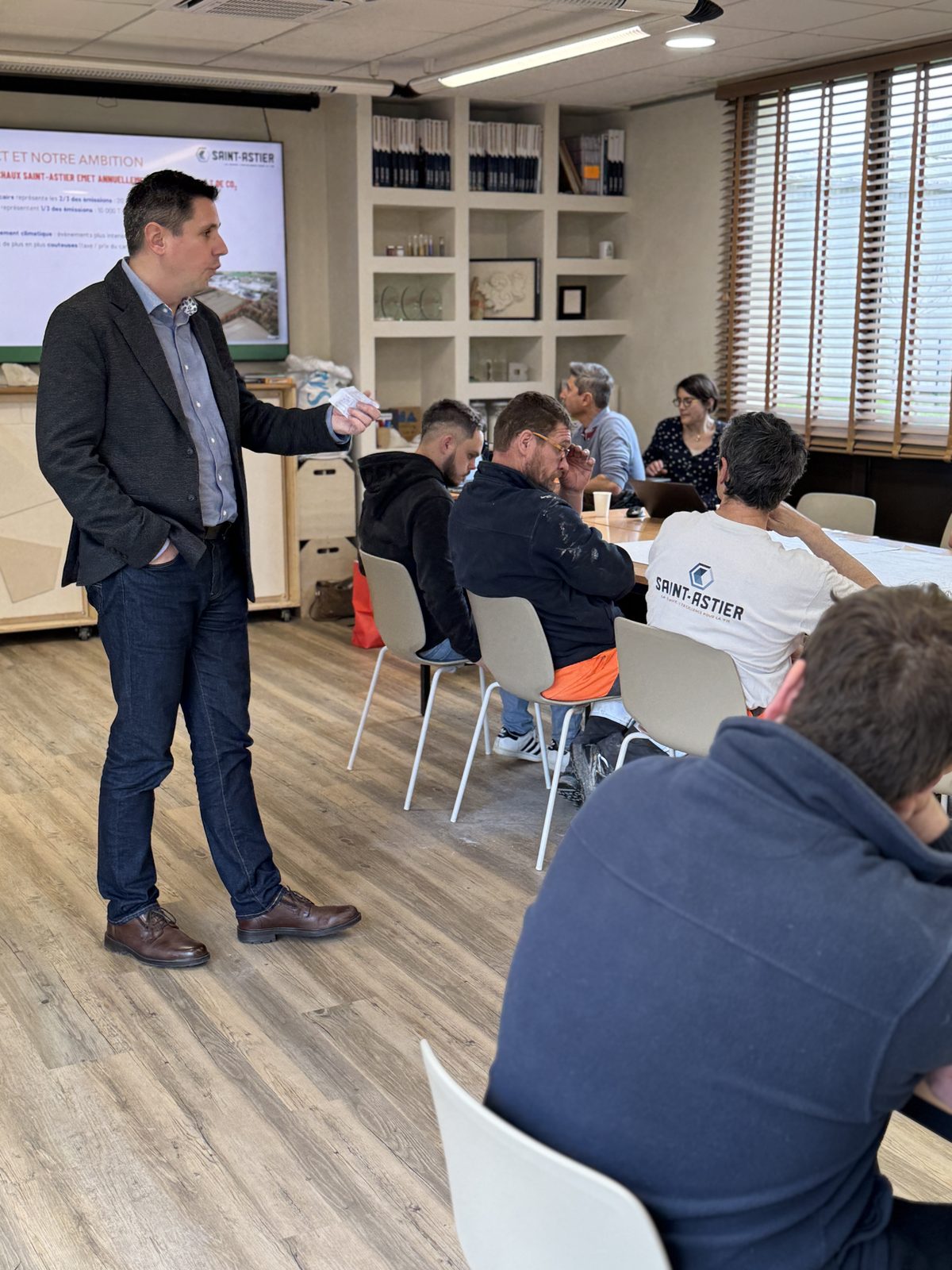
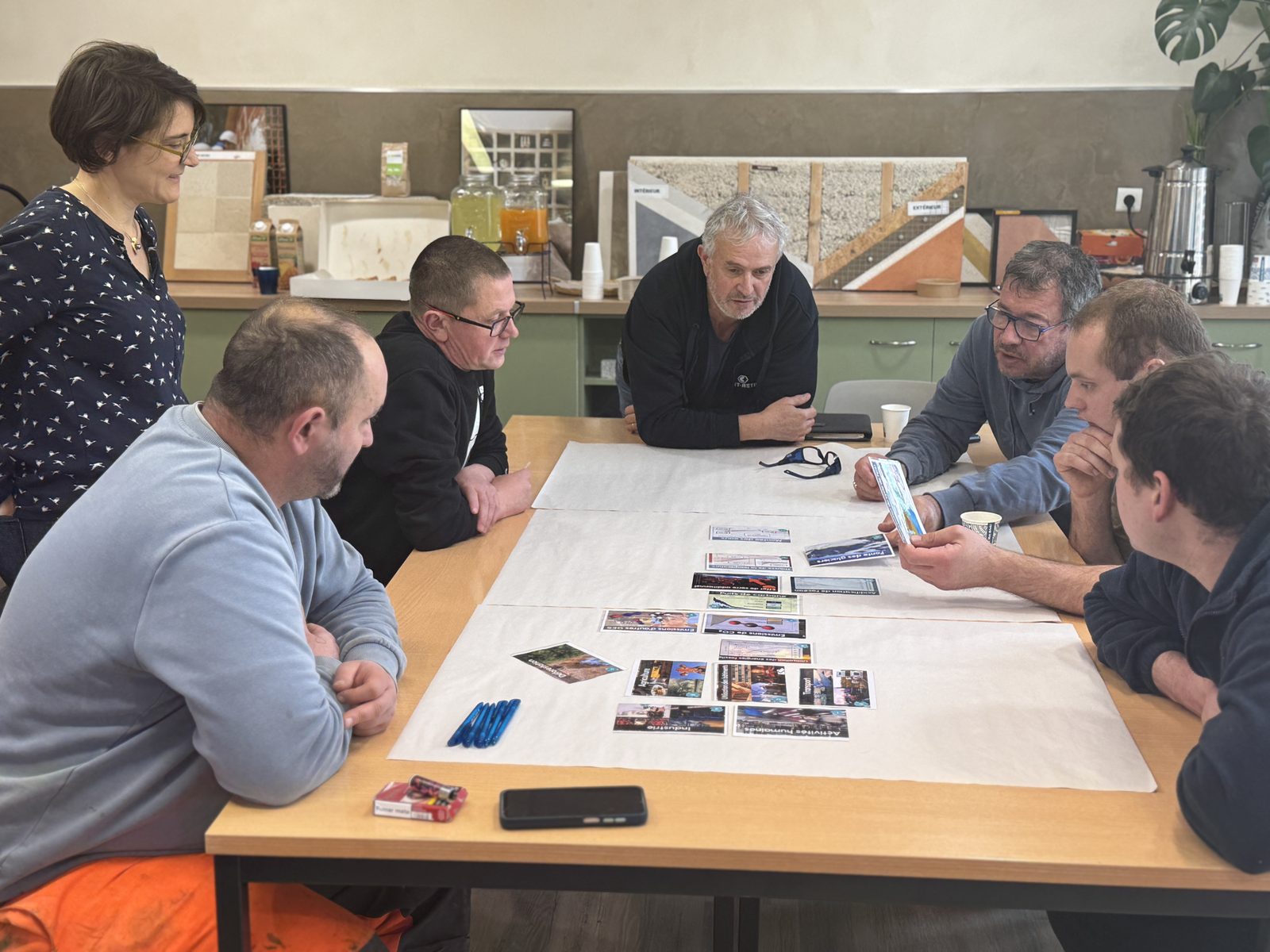
From late 2025 to May 2026, 10 “climate” training sessions were delivered to staff at the industrial sites (nearly 80 operational employees, but also the field sales force, laboratory, R&D, trainers, and administrative teams in France and abroad…), combining the Climate Fresk, the 2tonnes workshop and the concrete implications for Saint-Astier® in the short, medium and long term. Moments of dialogue and collective reflection, led internally by senior management and the CSR team, so that every employee fully takes ownership of the company's future challenges.

The ambition of an SME investing in line with its convictions
To turn its ambitions into reality, Chaux Saint-Astier® is currently investing the equivalent of its annual turnover to decarbonise its processes and enrich its future offering: low-carbon solutions, preservation of resources such as sand, energy sovereignty, and product innovation to meet the sector's environmental and societal challenges.
With nearly 150 employees, a turnover of around €40 million and a presence in 20 countries, Chaux Saint-Astier® shows that an industrial SME can commit to a structured, credible and differentiating climate and CSR transition.